

I Am Out with Lanterns, Looking for Myself.
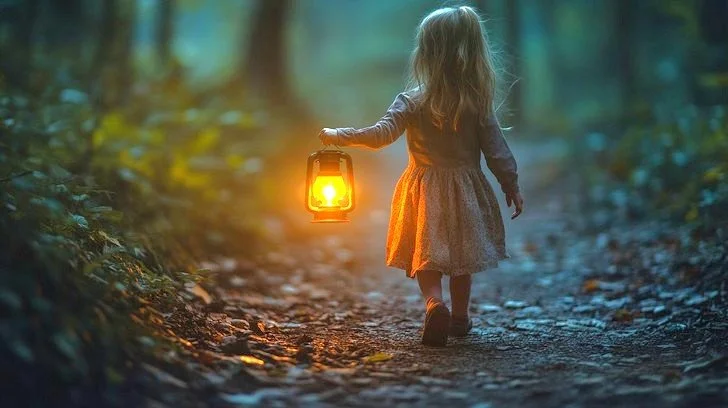
“I Am Out with Lanterns, Looking for Myself.”
—Emily DickinsonYou don't always realize how far life has carried you from yourself until you begin the process of coming back—especially when the leaving begins in childhood.
My journey back to myself started with an unsettling realization of how far away I actually was. It was like sitting somewhere on a bench absorbed in your book thinking you are alone, and then when you look up, you realize there is actually someone sitting next to you. When did they sit down? How long have they been there? How did I not notice? Except the person beside me was me.
The first intentional practices of being with myself reminded me of what it felt like as an adult to be alone with the parent who had never truly connected with me—someone who did not even really know me. The space between us felt familiar. It carried the same awkward silence: not knowing what to say, but no longer willing to fill the emptiness simply to make it bearable.
I had no idea how to relate to myself. I did not know what she felt, what she needed, or even what her favorite color was—not the color assigned to her because there were four children and everyone needed a different one, so we could be told apart. Not by who we were, but by a color. Mine was green.
There was grief in realizing that I did not know how to sit beside myself. I had spent so many years adapting to the emotional availability—or familiar unavailability—of others that I had never learned the language of my own inner world.
Even the reunion had to be forced.
After a particularly painful period—one shaped, in part, by choices I had made—I sat up in bed one morning with the sudden certainty that I could no longer continue as I had been. Something had to change. At that moment, a thought came to me with such clarity that it felt as though someone had spoken it aloud:
"No one is coming to save you".
It was sobering, but it was true. I could no longer keep waiting for someone else to make everything okay or at least keep me distracted enough not to care—to arrive with another dream I could disappear into, another role I could inhabit, or another life that would keep me from having to face my own.
The journey home began with a willingness to remain near myself while I still felt lost.
It meant telling myself the truth about who I had become and taking responsibility for the choices she had made, for neglecting her for years, while also offering compassion to the parts of her I had spent years hoping no one would ever see.
It was awkward. It was hard.
There were mornings when I did not want to get up. In those moments, it sometimes felt as though I had stepped outside myself and was speaking back to her from somewhere nearby.
“It’s okay,” I would say. “You can do this.”
And somehow, little by little, I became the one who stayed.
Separation from ourselves is not a personal failure. It is not even something we notice happening.
It begins quietly, at an age when staying connected to the people we depend on matters more than staying connected to ourselves. A child does not consciously choose between “me” and “them.” There is no real choice. A child cannot survive alone.
So we surrender what feels easiest and safest to surrender—our needs, our feelings, our truth, and sometimes all parts of ourselves—in order to preserve the connection we cannot survive without.
We leave ourselves because it is the only way we know to stay.
We leave because being with the truth of what it feels like to be us is too painful. We silence our needs when having needs threatens belonging. We become fluent in reading everyone around us while remaining strangers to ourselves. We take on the shame of "There is something fundamentally wrong about me."
Coming home means building a relationship with every part of us that learned to disappear—the one who became agreeable, stayed busy, needed to be needed, or abandoned herself/himself before anyone else could.
We return each time we honor our intuition instead of overriding it.
Each time we tell ourselves the truth, no matter how much it hurts or what it costs.
Each time we say "no" when everything in us feels obligated to say "yes."
Each time we allow a feeling without immediately trying to fix it.
Each time we refuse to leave ourselves to preserve a connection with someone else.
A lantern is not a spotlight. It does not reveal the entire path.
It gives us enough light for the next step.
Sometimes that step is sitting alone without distraction. Sometimes it is grieving how long we have lived outside ourselves. Sometimes it is asking, perhaps for the first time, “What do I need?”—and remaining present long enough to hear the answer.
Over time, the silence begins to change.
It becomes less like the strained silence between strangers and more like the quiet between two people who no longer need to fill the space between them.
Perhaps we are all out with lanterns, searching for the parts of ourselves we left behind in order to survive.
But the self we are looking for may not be far away.
She/He may be sitting quietly beside us, waiting for us to turn toward her/him and show her/him that this time, we are not going to leave.
Just Keep Going.
Arleen